
Utility companies nationwide are facing an increased load on their circuits as more people choose to purchase and drive electric vehicles.
The already aging grid will continue to be tested as EV adoption is expected to grow from 4.5 million in 2023 to 78.5 million by 2035, according to a recent
study from the Edison Electric Institute.
Several industry leaders have told Kforce that self-reporting of EV charging installations are likely only catching a small percentage of this growing population. And residential EV charging is projected to keep rising, due to factors such as lower cost of ownership and environmental impact.
To address this sharp increase in demand, utility companies must be proactive in figuring out how to accurately detect electric vehicles on the grid. If not, they may find out too late that their circuits are overloaded. Distribution operations leaders across the industry are sharing that this is no longer a problem they can ignore.
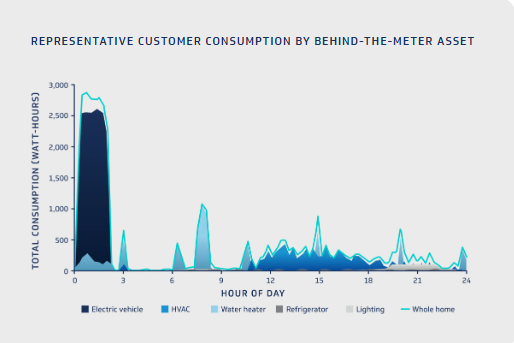
For example, at an average of 7200 watt-hours per level 2 charger, it’s not hard to see how just a few chargers can threaten an already fully loaded 50 kVA transformer.
When transformers are overloaded, the components can be damaged, leading to customer outages: the exact thing distribution leaders are trying hard to minimize.
Utility leaders are looking to develop the strategy and technology expertise needed to properly detect electric vehicles. Advanced analytics and AI can solve this prevalent challenge, but only if the company’s data is ready.